
MVP development: from idea to a working first release
— Short answer
An MVP is a first version that works well enough to test one hypothesis with real users and is kept as narrow as possible. We cut the scope with you and build the first release with senior engineers. Scope, timeline and cost are in writing before work starts, and you see real progress from week one. If you have an idea, a prototype or a half-finished project, we start where it fits you best.
Prototype, MVP and product: what is the difference?
In software, MVP stands for "minimum viable product": a first version that works well enough to test one hypothesis with real users, and is kept as narrow as possible. It has nothing to do with sports or Microsoft's MVP award. Mixing up three different stages leads to the wrong budget and the wrong expectations, so here they are side by side.
| Stage | Purpose | Who uses it | What it rests on | When it is enough |
|---|---|---|---|---|
| Prototype | To show an idea or quickly test an assumption | You, your team, a few investors or the first people you talk to | Often mock data, without real security or error handling | When explaining the idea, or checking that a flow makes sense, is all you need |
| MVP | To test a single hypothesis with real users | The first real users | A narrow but real and safe core flow | When you want to learn whether users truly do this job, and whether they will pay or spend time on it |
| Product | A business that is used continuously and grows | A broad user base | The full feature set, support, monitoring and scale | After what you learned from the MVP has confirmed your direction |
We do not treat an MVP as a demo. As we say on our home page, we write software that will not fall over under real users and real load, not a controlled demo, because a system that works, can be trusted and can be built on is still what matters most.
How do we cut the scope?
The biggest risk in MVP development is not technical; it is trying to fit everything into the first version. When we cut the scope, we look for the answers to four questions with you:
- Which is the one main flow? What is the single path that shows a user the value of your product? Only that path works at first.
- Which hypothesis are we testing? A sentence such as "users will do this" or "they will pay for that", which would change your decision whether it proves true or false.
- What is now, what is later, and what is never? Every feature falls into one of these three boxes. If the "never" box is empty, the scope has not been cut yet.
- How will we measure success? The yardstick that lets you say "it worked" or "it did not" after the first version.
Take an appointment app as an example. The main flow is a customer choosing a free slot and getting a confirmation. The hypothesis is that customers will choose this path instead of calling on the phone. The "now" box gets live availability and booking, with a mechanism that prevents double bookings. The "later" box gets automatic confirmation messages and advanced reports, and the "never" box gets whatever the first version does not really need. You can see how this flow is solved in a real system in the Booking & Reservation Platform case: when two people reach for the same slot at once, the first request wins and the second gets an honest "already taken."
Explaining the method with an example is easy; which feature goes into which box for your own project becomes clear in the first conversation.
If you already have an AI-built or no-code prototype
Today it is possible to turn an idea into a working screen just by chatting. As we also say on our home page, AI has shortened the path from an idea to working software; making the right call is still up to you. Such a prototype is a valuable start, but an MVP that will be opened to real users needs a separate look at these points:
- Identity and permissions. Does every user see only their own data?
- Data model and backups. Is the data left over from a quick decision on day one, can it be moved when it grows, and is it backed up?
- Error handling. When something goes wrong, what does the user see, and how do you find out?
- Security and secrets. Where do keys and access credentials live?
- Deployment and maintenance. Can an update be made without interrupting users?
The useful part of a prototype is often not the code itself but the screens, the flow and the feedback you got from your first users. We look at what you have together and decide, with the reasoning in writing, whether to build on it or start again. If you are building an AI-powered product, the details of the risks are on our AI integration page. The AI App Generation Platform in our portfolio shows how an idea that starts in a chat becomes a real, live app that runs in isolation.
When is it too early for an MVP?
Not every idea should turn into an MVP right away. In the following situations it is better to take a step back first:
- If there is no hypothesis to test. "A nice app" is not a hypothesis; if you cannot say what users will do or what they will pay for, the answer to that question should be sought first.
- If you cannot reach the first users. An MVP that is not tested with real users teaches nothing; it only creates cost.
- If nobody owns the scope. You do not gain speed when it is unclear who makes which decision in the first version.
If one of these applies to you, we say so in the first conversation; as we say on our home page, we talk honestly about whether it is the right time and the right fit.
How does the timeline work?
We do not give a duration figure on this page; the timeline is part of the written proposal, together with scope and cost, before work starts. Two things drive the timeline of an MVP the most: how narrow the scope is kept, and how fast decisions are made on your side. The bigger the scope, the further away the first version moves, which is why cutting scope is also the strongest tool for the timeline.
A written timeline gives you one more thing: you know what you will see and when. Once development starts, a live project panel opens in your account; status, offers, payments and a direct line to us are in one place. You see real progress from week one, not a proposal sitting in a drawer.
How we work
Every project goes through the same four steps from the first conversation to delivery; the Process page has the details. Our team has completed more than 200 projects to date.
- Discovery. We talk until both sides describe the same thing: what the product must do, who it is for and what counts as a good result. In an MVP this step is also where the scope cutting begins.
- A scoped proposal. What will be built, in what order and at what cost is written down; work does not start until you approve it. The plan you approve is the plan we run.
- Building, visibly. With the live project panel you follow progress and steer it while changes are still cheap.
- Review and handoff. You review what has been built, we refine it and hand it over.
What to bring to the first conversation
You do not need to come prepared; the first conversation is a real conversation. These four things speed it up:
- The idea and the hypothesis. In a sentence or two, tell us who has which problem and why you think this solution fits it.
- The first users. Do you know who you will test the first version with?
- What you already have. A prototype, screen sketches, competitor apps or a half-finished piece of work.
- Constraints. Is there a demo date, an investor meeting or a delivery promised to a first customer?
What happens after the MVP?
When the first version has answered your question, the next decision is yours. We build the software as a foundation that can be built on; the second scope decision becomes a new written proposal, based on what you learned from the first version.
| Path | When it makes sense | Next step |
|---|---|---|
| Grow | Users used the main flow the way you expected and want more | Put the features in the "later" box in order |
| Change direction | Users use the product, but for a different purpose than you had in mind | Rewrite the hypothesis and cut a new, narrow scope |
| Stop | The hypothesis proved wrong, and you saw it while that was still cheap | Write down what you learned; the most expensive mistake is the one found late |
If your first version is a phone app, the details are on our mobile app development page; when the product grows and needs business rules specific to you, our custom software development page is the place to continue.
Once you are live we give a full year of direct support; we do not hand over and disappear. Support beyond that, such as new features, monitoring and updates, is sized to the project. Because platforms do not stand still, on projects we look after we keep an eye on what yours depends on and tell you what needs attention.
Source code, infrastructure and handover
Once the project is paid in full, the delivered work is yours. What we had before your project, such as our own tools, libraries and frameworks, stays ours; the provision is written on the Terms page.
Unless you would rather handle it yourself, we set up and manage everything your project runs on, including hosting, domains, storage and the deployment pipeline, so you get a production-ready system without having to become an infrastructure expert. If you have your own cloud accounts, or your organization wants everything under its own roof, we deploy there. Access details you share are stored encrypted and used only for your project. If you ever want to bring the infrastructure in-house or move it to another team, we are with you for a clean handover, with accounts, domains and documentation. Nothing we run for you is a reason you cannot leave.
Who we are not a fit for
- If you want everything in the first version. The point of an MVP is cutting scope; an MVP that refuses to cut turns into a product project that drags on.
- If you only want an impressive prototype for an investor pitch. We build a working first version that will be opened to real users; a demo shown only alongside a slide is not our work.
- If you are looking for a guarantee of investment or sales. We build the software properly, but we cannot guarantee that your product will take hold in the market.
Frequently asked questions
How long does an MVP take?
It depends on the scope, so we do not give a duration figure on this page. What drives it most is how narrow the scope is, which systems have to be connected and how fast decisions are made on your side. The timeline is part of the written proposal, together with scope and cost, before work starts.
What does the cost of an MVP depend on?
The complexity of the main flow, the user roles, the outside systems to be connected, the features used (such as payments, notifications or location) and the support expected after launch. Once the scope is settled in the written proposal, the price does not change afterwards.
I already have a prototype. Do you start from scratch?
That depends on what you have. As we also say on our home page, you can come with an idea, a need or a half-finished project; we start where it makes the most sense for you. We look at what you have together and decide, with the reasoning, whether building on it or starting again is the better route.
Who owns the code?
Once the project is paid in full, the delivered work is yours. What we had before your project, such as our own tools, libraries and frameworks, stays ours. What is binding is the written agreement signed for your engagement.
Is an MVP enough for investment?
We cannot guarantee that; what an investor looks at varies by sector and stage. A first version that works with real users and can be measured may be part of the evidence you show an investor, but the investment decision is not in our hands.
What happens after the MVP?
We make the next scope decision together, based on what you learned from the first version, and put the new scope into a written proposal. Once you are live we give a full year of direct support; support beyond that is sized to the project.
Selected work
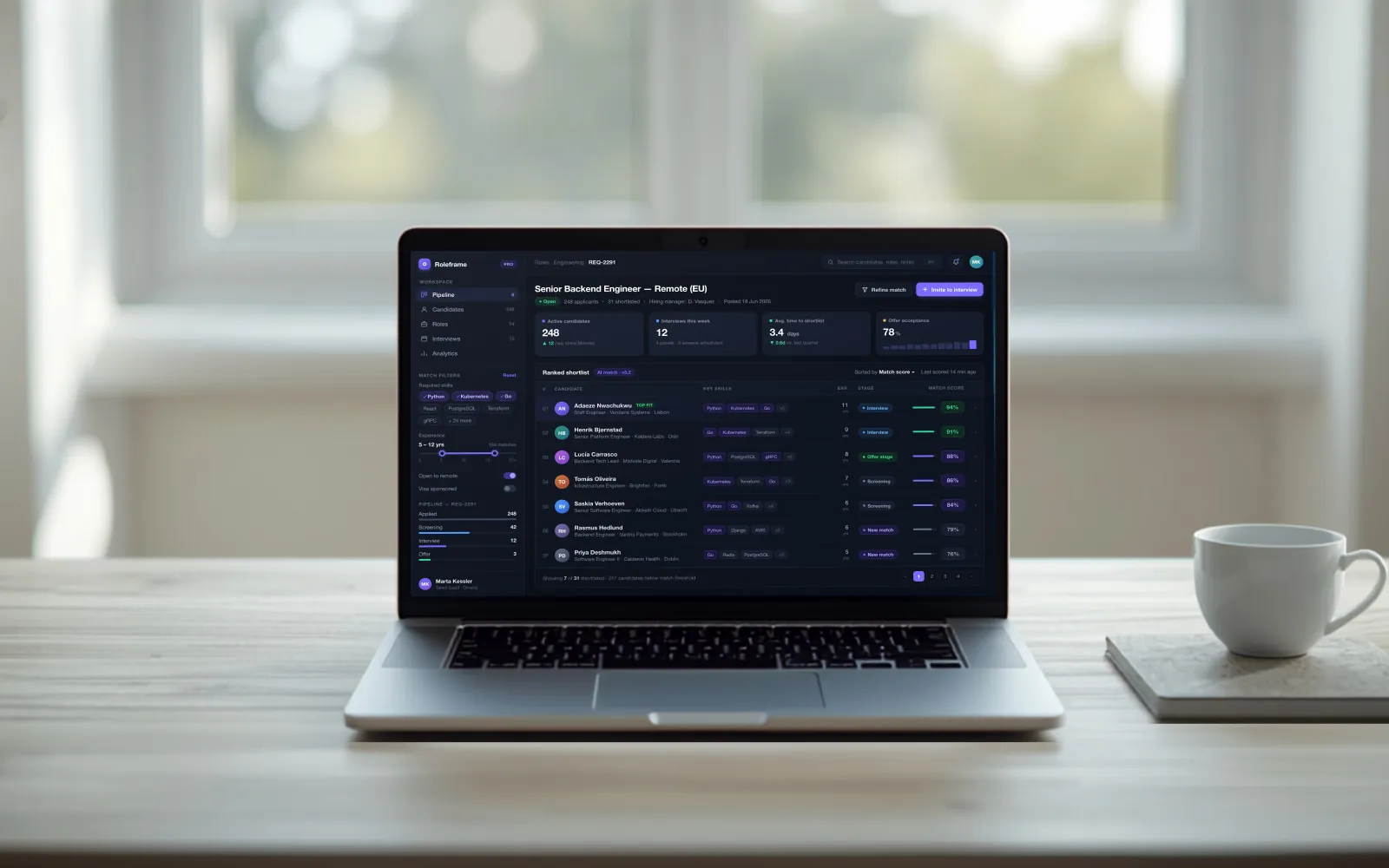
Talent Matching Platform
It started from a single question: how do you tell a strong fit from a lucky guess? The answer was a flow that scores and ranks every candidate against every open role.
View case study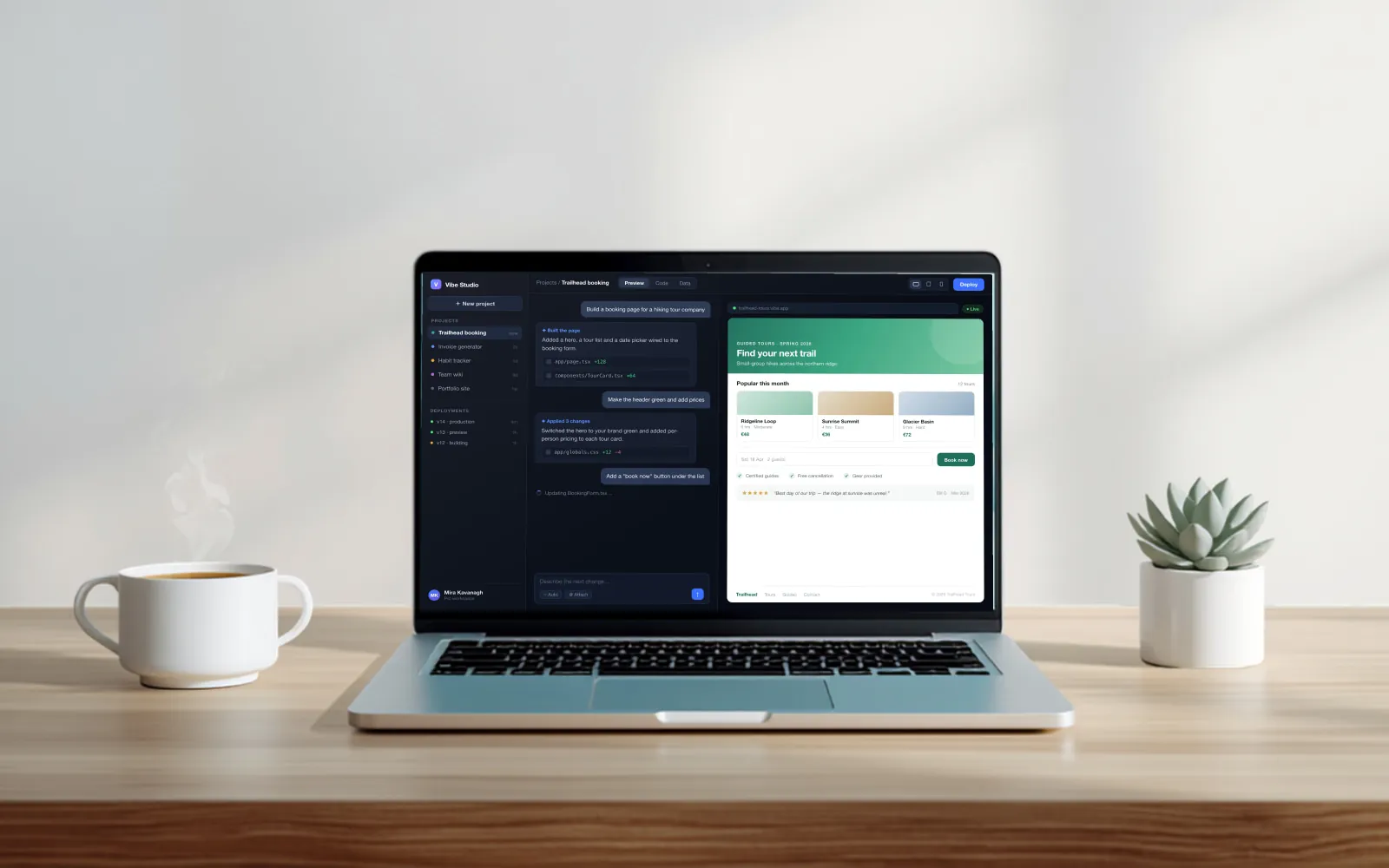
AI App Generation Platform
Handing back a real, live app instead of a mockup: the path from idea to working software is exactly what this platform produces.
View case study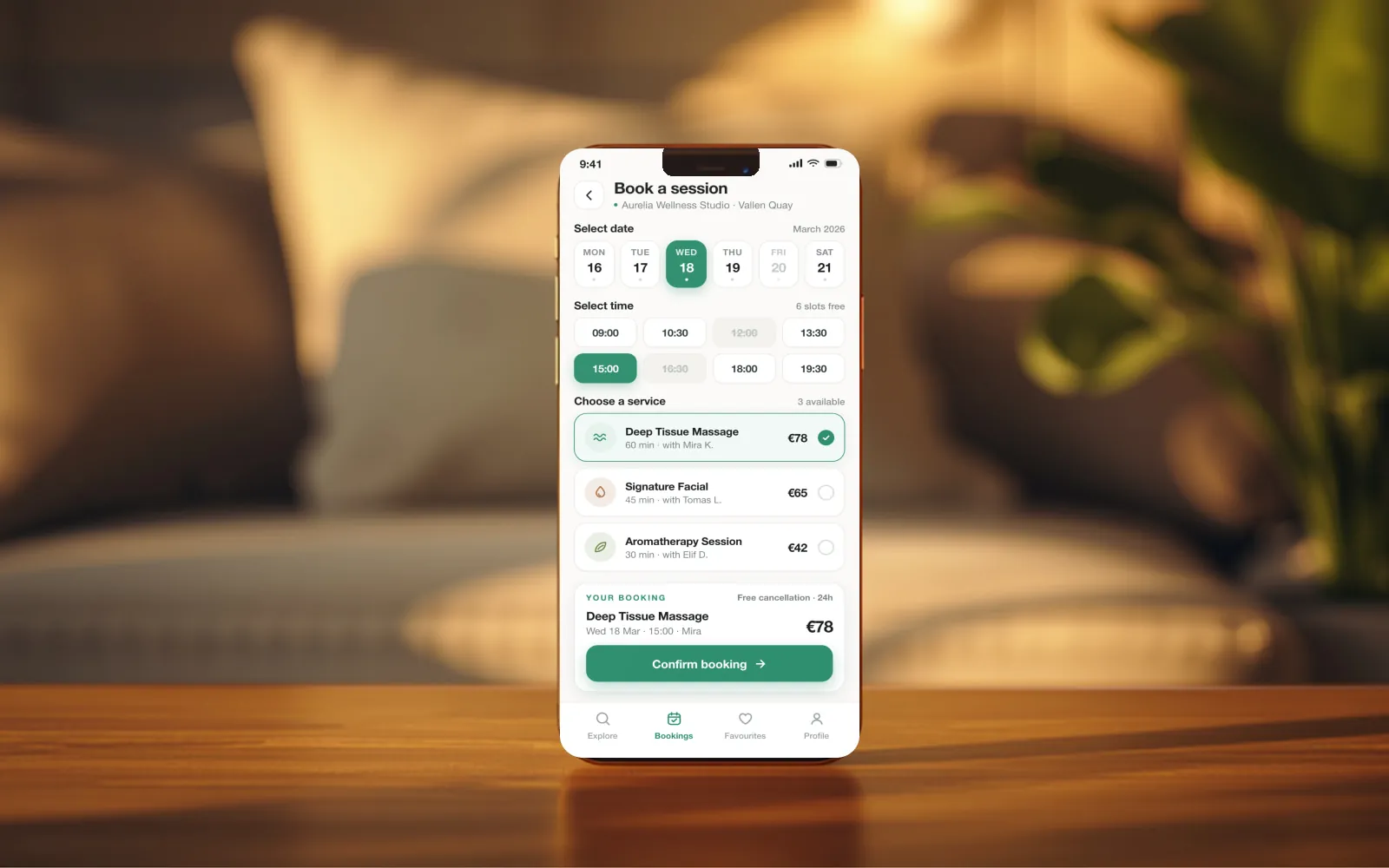
Booking & Reservation Platform
The core flow is single and clear: a customer picks a free slot from a live calendar and the confirmation sends itself. The mechanism that prevents double bookings is the detail that makes the flow real.
View case studyRelated services
Engineering notes
Let's pin down your project
Tell us what you want to build. We put scope, timeline and cost in writing before any work starts.
Last updated: